Supplement Excipients Explained: Fillers, Binders, Flow Agents and What "No Fillers, No Binders" Really Means

Turn over almost any supplement bottle and the ingredient list splits in two. Above the line are the vitamins, minerals, botanicals or proteins the customer is paying for. Below it, under "other ingredients", sit the substances nobody asked for: microcrystalline cellulose, magnesium stearate, silicon dioxide, hypromellose, croscarmellose sodium. These are excipients, and they usually account for a large share of what is in the capsule or tablet. This article explains what each class of excipient does, why a manufacturer cannot simply leave them out, which ones regulators have restricted, and what the increasingly common "no fillers, no binders" claim does and does not tell a buyer.
Quick answer: Excipients are the non-active ingredients that make a supplement physically possible: fillers give a small dose enough bulk to fill a capsule, binders hold a tablet together, disintegrants make it break apart in the stomach, lubricants and flow agents keep powder moving through high-speed machines, and coatings and colours protect or identify the finished unit. In Malaysia, the European Union and the United States they must come from permitted lists and be declared on the label, although the wording of that declaration differs by market. The main regulatory change of recent years is the European Union's removal of titanium dioxide (E171) from the permitted list in 2022, a decision the United States has not followed. A "no fillers, no binders" claim is rarely a claim of zero excipients; the practical check is to read the "other ingredients" line and ask the manufacturer what each item is for.
Key takeaways
- Excipients commonly make up a third to two-thirds of a capsule's fill weight and the majority of a tablet's weight. They are not padding for its own sake; each class solves a specific manufacturing or performance problem.
- The usual levels are small for functional additives (lubricants and flow agents typically below 2% of the formula) and large only for fillers, which exist because a 50 microgram dose cannot be metered or swallowed on its own.
- Magnesium stearate and silicon dioxide, the two most criticised excipients online, were both re-evaluated by the European Food Safety Authority in 2018 and found to raise no safety concern at reported use levels. The real formulation risk with magnesium stearate is dissolution, not toxicity, and it is managed by dose and mixing time.
- Titanium dioxide (E171), the white opacifier in many tablet coatings and capsule shells, has not been permitted in food or food supplements in the European Union since 2022. It remains permitted in the United States, where a petition to revoke it is still under review.
- "No fillers" products usually still contain flow agents, capsule shells and sometimes a filler under another name such as rice flour or "rice concentrate". The claim is a marketing position, not a regulatory category.
- Excipients are cheap per kilogram but expensive in consequence: they decide the capsule size, the number of units per daily dose, the bottle size and therefore the unit cost and the shelf appearance of the product.
Who this is for: founders and brand managers reviewing a manufacturer's proposed formula, buyers comparing quotations that list different excipient systems, and marketers deciding whether a "clean label" or "no fillers" position is defensible for their product. It covers capsules, tablets, powders and gummies sold as health supplements, with reference to Malaysian, European and United States rules. It is not regulatory advice for a specific product, and the permitted-substance lists change, so the current edition of each regulator's guidance should be checked before a formula is finalised.
What are excipients and why does every supplement need them?
An excipient is any ingredient in a finished supplement that is not there to deliver a nutritional or physiological effect. The word comes from the Latin for "to take out" or "receive", and the role is exactly that: to receive the active ingredient and carry it in a form that can be manufactured consistently, survive its shelf life, be swallowed, and release the active where it is supposed to be released. A pharmacist in the nineteenth century mixing a powder with lactose and gum arabic before pressing it into a pill was using excipients; a modern capsule line running at 100,000 units an hour depends on them far more heavily.
The need becomes obvious when the dose is small. A vitamin D3 capsule may contain 25 micrograms of the active, which is a speck invisible to the eye. No filling machine can meter that amount directly into a capsule with acceptable accuracy, and no consumer could handle it as a powder. The active is therefore pre-blended into a carrier such as microcrystalline cellulose or rice flour so that each capsule receives, say, 300 milligrams of blend containing exactly 25 micrograms of D3. The carrier is doing real work: it is what makes the dose uniform from the first capsule to the hundred-thousandth. The same logic applies to high-potency minerals, probiotics and botanical extracts standardised to a few milligrams of marker compound.
Even when the dose is large, excipients remain. A 500 milligram vitamin C tablet cannot be made from ascorbic acid alone because the crystals do not stick together under compression, the resulting tablet would not break up in the stomach, and the powder would cling to the punches of the tablet press. Each of those problems has an excipient class dedicated to solving it. For products where the dose is in grams, such as protein or electrolyte powders, the excipient question shifts from fillers to anti-caking agents, sweeteners and flavours, which was touched on in the guide to choosing a supplement dosage form.
What does each class of excipient actually do?
Excipients are best understood by function rather than by name, because the same substance can play more than one role and several different substances can play the same role. The table below groups the excipients that appear most often on supplement labels, with the approximate proportion of the formula each typically occupies and the consequence of removing it. The proportions are typical ranges drawn from standard formulation practice; a specific product's figures belong on its manufacturer's formula sheet.
| Function | Common examples on labels | Typical share of formula | What it solves | What happens without it |
|---|---|---|---|---|
| Filler / diluent | Microcrystalline cellulose, rice flour, maltodextrin, dicalcium phosphate, lactose | 20 to 70% in capsules and tablets with small actives; near zero with gram-level actives | Gives a tiny dose enough bulk to be metered and swallowed; dilutes potent actives to a uniform blend | Dose varies capsule to capsule; half-empty capsules; tablets too small to handle |
| Binder | Microcrystalline cellulose, hypromellose (HPMC), povidone, pregelatinised starch | 2 to 10% in tablets; not needed in most capsules | Holds compressed particles together so the tablet survives bottling and transport | Tablets crumble, cap or chip; high reject rates on the line |
| Disintegrant | Croscarmellose sodium, sodium starch glycolate, crospovidone | 0.5 to 5% in tablets | Swells in water so the tablet breaks apart and the active can dissolve | Tablet passes through the gut largely intact; fails disintegration testing |
| Lubricant | Magnesium stearate, stearic acid, sodium stearyl fumarate | 0.25 to 2% | Stops the blend sticking to tablet punches, dies and capsule dosing pins | Sticking and picking on the press; machine stops; damaged tablets |
| Glidant / flow agent | Silicon dioxide (silica), talc, tricalcium phosphate | 0.1 to 1% | Makes the powder flow evenly into the dosing chamber so every unit receives the same weight | Bridging in hoppers; weight variation; failed uniformity tests |
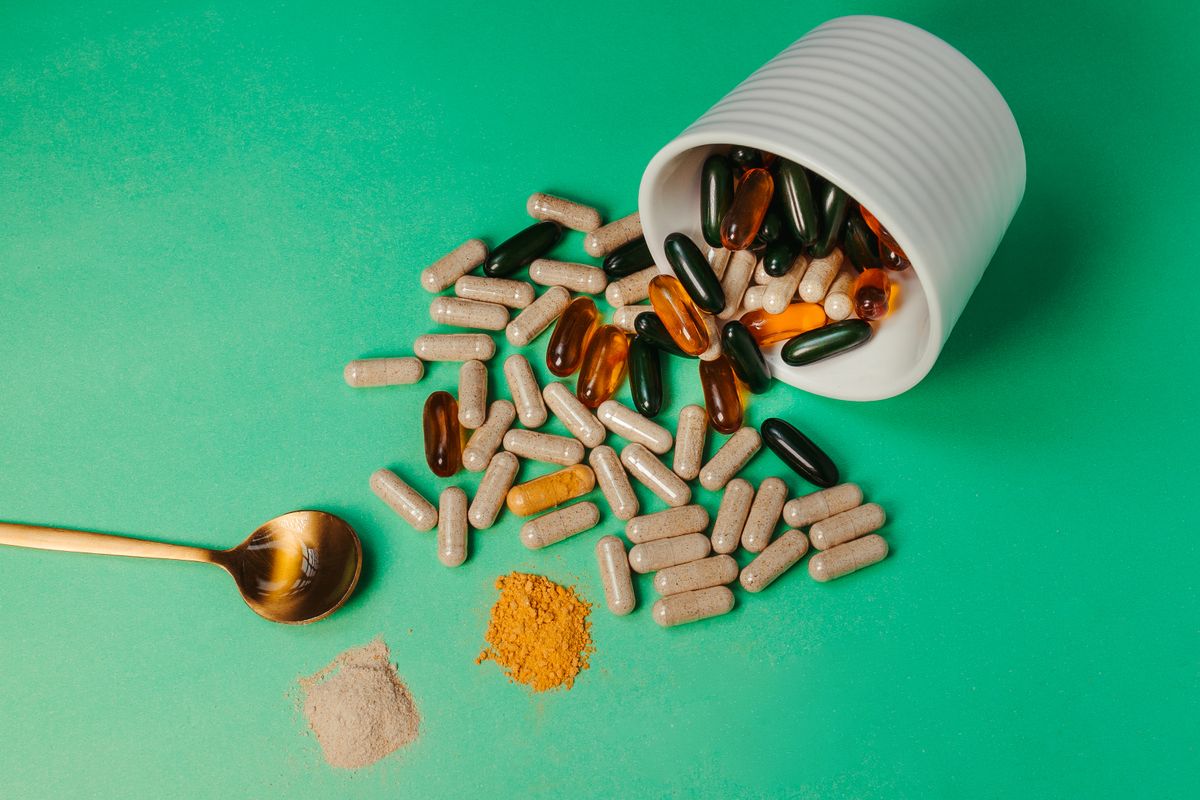
| Capsule shell | Gelatin (bovine, fish), hypromellose (vegetarian), pullulan | About 15 to 25% of the finished capsule weight | Contains the fill; masks taste; dissolves in the stomach | No capsule; the same powder would need to be a tablet or sachet |
| Coating | Hypromellose film, shellac, enteric polymers, carnauba wax | 2 to 5% of tablet weight | Protects light- or moisture-sensitive actives; eases swallowing; delays release | Faster degradation; bitter taste; dusting in the bottle |
| Colour / opacifier | Titanium dioxide (where permitted), iron oxides, calcium carbonate, natural pigments | Under 1% | Uniform appearance; hides fill colour; brand identification | Translucent capsules showing uneven fill; batch-to-batch colour drift |
Two points follow from the table. First, the excipients that attract the most criticism online, lubricants and flow agents, are present in the smallest amounts and are the hardest to remove, because the machinery will not run without them. Second, the excipient that occupies the most space, the filler, is the easiest to argue about, because its quantity is a design choice: a formulator can shrink it by using a smaller capsule, raise it to make a capsule look fuller, or replace it with a second active that happens to have good bulk properties.
How does a manufacturer decide which excipients to use?
The excipient system is settled during formulation development, before any production batch is made, and it is driven by the active ingredient's physical behaviour rather than by preference. A development team will measure the bulk density, particle size, moisture sensitivity and flow of each active, then build a blend that fills the chosen capsule size to a consistent weight and passes the disintegration and uniformity tests the regulator expects. In a contract manufacturing setting this is the work of the product development and R&D function, which will usually run trial blends on the actual filling or compression equipment, because a formula that flows on a bench can still bridge in a production hopper.
The constraints are practical. Hygroscopic actives such as magnesium citrate or many plant extracts pull in moisture and turn sticky, so they need a higher proportion of silica and sometimes a desiccant in the bottle, which was one of the manufacturing points raised in the article on magnesium supplement forms. Oily actives such as vitamin E or fish oil are usually sent to softgels instead, where the excipients become the gelatin shell, glycerin plasticiser and a carrier oil. Probiotics must avoid excipients with free moisture and are often blended with a protective matrix. Botanical powders with poor compressibility need more binder if they are to be tabletted, or move to capsules to avoid the problem altogether.
Cost enters through the capsule count rather than the excipient price. Most excipients cost a few dollars a kilogram and are present in grams per thousand units, so their direct contribution to unit cost is small. Their indirect contribution is large: a formula that needs 40% filler to flow properly may push a daily dose from one capsule to two, which doubles the capsule shells, the filling time and the bottle size. A brand asking a manufacturer to remove a filler is therefore not asking to save money on cellulose; it is asking the manufacturer to find another way to make the dose uniform, which may mean a smaller capsule, a different active grade or a slower filling speed.
Are magnesium stearate and silicon dioxide safe?
Both have been reviewed by the European Food Safety Authority (EFSA) and neither was found to raise a safety concern at the levels used in food and supplements. In its 2018 re-evaluation of sodium, potassium, calcium and magnesium salts of fatty acids (E 470a and E 470b), the group that includes magnesium stearate, the EFSA Panel concluded that there was no need for a numerical acceptable daily intake and that the additives were of no safety concern at reported uses. It noted that the fatty acid portion contributed at most about 5% of dietary saturated fat intake, and that the available mutagenicity tests on magnesium stearate were negative. The Panel did flag that toxicity data for the salts themselves were limited and recommended that trans fatty acid limits be considered in the specifications.
Silicon dioxide (E 551) was re-evaluated in the same period. EFSA's opinion on silicon dioxide as a food additive found no indication of toxicity at reported use levels and no genotoxicity concern, with the highest exposure estimates sitting at least tenfold below the highest doses tested. Its main criticism was of the specification rather than the substance: the existing EU specification did not adequately characterise the particle size of the material, and EFSA called for a clear particle size distribution to be added. That is a request to regulators and suppliers, not a finding against the additive.
The genuine technical issue with magnesium stearate is not safety but dissolution. It is a hydrophobic lubricant that works by coating particles, and if too much is used or the blend is mixed for too long after it is added, the coating can slow how fast the tablet or capsule contents wet and dissolve. This is a well-known effect in pharmaceutical formulation and it is managed by keeping the level low, adding the lubricant last and limiting mixing time. A brand that wants assurance should ask for disintegration results rather than for the lubricant to be removed. The United States Pharmacopeia's general chapter <2040> Disintegration and Dissolution of Dietary Supplements sets the standard methods and acceptance criteria, including a 30-minute disintegration limit for most tablets and capsules and a rupture test for softgels, and a manufacturer with a working excipient system should be able to show results against it as part of its finished-product testing.
Why was titanium dioxide banned in Europe, and what replaced it?
Titanium dioxide was for decades the default white opacifier in tablet coatings and capsule shells, and its removal in the European Union is the single largest excipient change of recent years. In May 2021 EFSA published a re-assessment concluding that E171 could no longer be considered safe as a food additive, because a concern for genotoxicity could not be ruled out and an acceptable daily intake therefore could not be set. The Panel was careful to say that evidence of general toxicity was not conclusive and that absorption after ingestion is low, but under EU food law an additive without an established safe intake cannot stay on the list.
The European Commission acted on that opinion through Commission Regulation (EU) 2022/63, which deleted titanium dioxide from the permitted food additive list, including the food supplements category, with effect from 7 February 2022 and a sell-through period for existing stock to 7 August 2022. The regulation kept E171 provisionally available as a colour in medicines pending a separate review. The practical result is that any supplement intended for the EU market now needs a titanium-free coating or shell, and suppliers have responded with white alternatives based on calcium carbonate, rice starch, modified starches and calcium phosphate, each with slightly different opacity and processing behaviour.
Other markets have not followed. The United States Food and Drug Administration states on its page on titanium dioxide as a colour additive in foods that it continues to allow the use under 21 CFR 73.575, provided the quantity of titanium does not exceed 1% by weight of the food, and that it is reviewing a colour additive petition filed in April 2023 asking it to repeal that listing. A brand selling into both regions therefore faces a choice: run two coating systems, or move to a titanium-free formula everywhere and accept a slightly higher coating cost. Most export-oriented manufacturers have taken the second path, since one formula is simpler to control than two.
How are excipients regulated and labelled in Malaysia, the EU and the US?
In all three jurisdictions excipients must come from a permitted list and must be declared, but the mechanics differ. In Malaysia, health supplements are registered with the National Pharmaceutical Regulatory Agency (NPRA) under the Drug Registration Guidance Document, and the specific requirements sit in its Appendix 6, Guideline on Registration of Health Supplements. The registration dossier declares the full formula including every excipient and its function, and excipients are checked against NPRA's permitted, prohibited and restricted substance lists. For additives NPRA also recognises the ASEAN Guiding Principles for the Use of Additives and Excipients in Traditional Medicines and Health Supplements, a harmonised reference developed by the ASEAN working group that Singapore's Health Sciences Authority describes on its ASEAN harmonisation page. Changing an excipient after registration is a variation that must be notified, which is one reason manufacturers resist late requests to swap a filler.
In the European Union, supplements are foods, so excipients are food additives governed by Regulation (EC) No 1333/2008 and must appear in its Annex II for the food supplement category; the titanium dioxide deletion above was an amendment to that annex. Additives are declared in the ingredient list by functional category and name or E-number, for example "anti-caking agent: silicon dioxide". In the United States, supplements are regulated under 21 CFR Part 111, the current good manufacturing practice rule for dietary supplements, which requires written specifications for every component including excipients, and the labelling rule at 21 CFR 101.36 requires non-dietary ingredients to be listed below the Supplement Facts panel under the heading "Other ingredients", in descending order of weight. The general rules for what must appear on a pack were covered in the guide to product labelling for health and beauty brands.
What every system shares is the expectation that each excipient arrives with a specification and a certificate of analysis from its supplier, is tested or verified on receipt, and is traceable to a lot. A manufacturer that cannot produce the certificate for its magnesium stearate is a bigger concern than one that uses magnesium stearate, a point that applies to every raw material and was set out in the guide to reading a certificate of analysis.
What does "no fillers, no binders" really mean on a label?
In most cases it means the product uses fewer excipients than a conventional one, not none, and the claim should be read against the "other ingredients" line rather than taken at face value. There is no regulatory definition of "filler-free" in Malaysia, the EU or the US, so the phrase is a marketing position. Three patterns are common. The first is a capsule whose active dose is large enough to fill the shell without a diluent, such as a 500 milligram turmeric or 600 milligram magnesium citrate capsule; here the claim is literally true for fillers, but the product will still usually carry a flow agent and of course a capsule shell. The second is a product that has replaced microcrystalline cellulose with an ingredient that performs the same bulking role but reads more naturally, typically rice flour, "rice concentrate" or an inert botanical powder; the function has not changed, only the name. The third is a product that has genuinely removed glidants and lubricants by running the filling machine slowly and accepting more weight variation, which is possible at small scale and expensive at large scale.
None of these is dishonest, but a buyer should know which one is being offered. The questions that resolve it are simple: what is every item under "other ingredients" for, what capsule size and fill weight does the formula use, and what disintegration and weight-uniformity results support it. A manufacturer that can answer in those terms has designed the excipient system deliberately. One that answers only with the claim has not. The same discipline that governs health claims, covered in the article on what health and beauty brands can legally say, applies here: a claim about what is absent must be as accurate as a claim about what is present.
Gummies deserve a separate note because they invert the usual ratio. In a gummy the excipients are the product: sugar or sugar alcohols, pectin or gelatin, citric acid, flavour and colour make up well over 90% of the weight, and the active is dispersed through them. A "clean label" gummy is therefore a negotiation over sweeteners and colours rather than over fillers, and the active loading it can carry is limited by how much the gel can hold without weeping or becoming unpalatable.
Practical checklist for reviewing a proposed formula
- Ask for the formula sheet with every excipient, its function and its percentage, not just the label wording. A manufacturer should have this before quoting.
- Check the capsule size and fill weight against the daily dose. If the active content is small and the capsule is large, the filler is doing most of the work and the brand is paying for capsule shells and bottle space to carry it.
- For tablets, ask for disintegration results against the pharmacopoeial method, and for capsules ask for weight-uniformity data. These prove the excipient system works better than any claim about it.
- If the product is for export, confirm the coating or shell is free of titanium dioxide where the destination market requires it, and check that colours are permitted in every target market, not just the home one.
- Ask for the supplier certificate of analysis and the allergen and source statement for each excipient, especially for gelatin (bovine, porcine or fish), lactose and any starch, since these decide Halal, vegetarian and allergen positions.
- Decide the "clean label" position before formulation starts. Removing an excipient after the formula is registered means a variation filing, a new stability study and possibly a new capsule size.
Frequently asked questions
Are excipients bad for you?
The excipients permitted in supplements have been assessed by food or pharmaceutical regulators and are used at low levels, and the two most criticised, magnesium stearate and silicon dioxide, were both found by EFSA in 2018 to raise no safety concern at reported uses. Individual sensitivities exist, for example to lactose or to specific colours, which is why full declaration matters. The one widely used excipient that has been withdrawn on safety grounds is titanium dioxide in the EU, and that decision rested on an inability to rule out a concern rather than on demonstrated harm.
Why does my capsule look half empty?
Because the manufacturer chose a capsule size for the dose and the powder's density, and powders settle in transit. Fill weight is controlled, fill volume is not, so a dense blend can occupy well under the shell's capacity. Adding filler to make the capsule look full is possible but increases cost and is a cosmetic rather than a quality choice. The uniformity of weight across capsules is the measure that matters.
Is a vegetarian capsule an excipient?
Yes. The shell, whether gelatin or hypromellose (HPMC), is a non-active ingredient and appears under "other ingredients" or in the ingredient list. Hypromellose shells are plant-derived and suit vegetarian and most Halal positions; gelatin shells need a declared source. Shell choice also affects moisture behaviour, as hypromellose shells hold less water and suit hygroscopic fills better.
Can a manufacturer make my product with zero excipients?
Only in narrow cases, such as a single active with good flow at a dose that fills the capsule, or a loose powder in a sachet. Tablets cannot be made without at least a binder and lubricant, and most capsule lines need a glidant to meet weight uniformity at commercial speed. A request for zero excipients is usually best reframed as a request for the minimum excipient system that still passes the tests.
Do I have to list excipients on the label in Malaysia?
The full formula including excipients is declared to NPRA in the registration dossier, and the approved label follows NPRA's labelling requirements for registered products. Requirements for which excipients appear on the pack and how they are expressed are set out in the Drug Registration Guidance Document and its appendices, which are revised periodically, so the current edition should be checked for a specific product rather than relying on a general summary.
Why did the manufacturer change an excipient without telling me?
Under a proper change-control system it should not happen without notice, because an excipient change can affect dissolution, stability and the registration itself. If a supplier discontinues a grade, the manufacturer should propose a replacement, run comparative testing and, where the product is registered, file the variation. A brand should expect to be told, and should ask for the supporting data.
Sources and limitations
Regulatory statements in this article rely on the European Food Safety Authority's 2021 news release and 2018 re-evaluation opinions, Commission Regulation (EU) 2022/63 on EUR-Lex, the US Food and Drug Administration's titanium dioxide page and the Electronic Code of Federal Regulations, the United States Pharmacopeia's general chapter <2040> listing, NPRA's Appendix 6 guideline page and the Health Sciences Authority's ASEAN harmonisation page, all accessed on 30 October 2026. Typical excipient percentages and capsule shell proportions are drawn from general formulation practice and vary by product; they are offered as orientation, not as specifications. Regulatory lists and editions change, and the FDA petition on titanium dioxide was still under review at the time of writing, so the current status should be confirmed before a formula or label is finalised.
Creaton Poh is the pen name of Poh Tze Kheng, founder of ORIZI Group — one of Malaysia's most comprehensive one-stop OEM, ODM, private label and contract manufacturing groups, spanning skincare, cosmetics, personal care, perfume and fragrance, supplements, functional food and nutrition, pet care, home care and medical devices. Across six specialised companies and three manufacturing divisions, the Group brings together 20+ years of industry experience, 5,000+ formulations, and internationally recognised quality, manufacturing and regulatory standards. These articles are written to educate, not to promote.
Written by Creaton Poh
Industry Researcher • Author • Vlogger • Manufacturing Strategist
Turning ideas into products. Turning experience into knowledge.
Connect with Poh Tze Kheng on LinkedIn.


Comments
Post a Comment