Creams, Lotions and Emulsions Explained: Why Formulas Separate and How Manufacturers Keep Them Stable

Most creams and lotions on a bathroom shelf are emulsions: oil and water, two liquids that do not naturally mix, held together as tiny droplets. When the formula is right, the product stays smooth and uniform for its whole shelf life. When it is not, a layer of oil appears on top, the texture turns grainy, or a pump starts dispensing watery liquid. This article explains what an emulsion is, the main types used in skincare and personal care, the specific ways emulsions fail, and the formulation, manufacturing and testing steps that keep a cream stable from the first batch to the last jar.
Quick answer: An emulsion is a mixture of oil and water in which one liquid is dispersed as droplets inside the other, held in place by emulsifiers and thickeners. Most lotions and creams are oil-in-water (water is the continuous phase, so they feel light and wash off easily); richer, more water-resistant products are often water-in-oil. Emulsions are never permanently stable in a physical sense — they separate through creaming, flocculation, coalescence and Ostwald ripening — so stability is engineered through emulsifier choice, droplet size, viscosity, process control and testing. A brand owner should judge a sample not only on how it feels on day one, but on how it behaves after heat, cold, time and transport.
Key takeaways
- Creams and lotions are emulsions; their texture and stability depend on which phase is continuous and how small and evenly distributed the droplets are.
- Separation happens in stages: creaming and flocculation can often be reversed by shaking, while coalescence and full phase separation cannot.
- Smaller droplets, a higher-viscosity continuous phase and a smaller density difference between the phases all slow separation.
- The manufacturing process — temperature, shear, order of addition and cooling rate — affects stability as much as the ingredient list does.
- Stability must be demonstrated through testing; there is no single international test protocol, so the manufacturer has to define and justify one.
Who this is for: founders and product teams developing a cream, lotion, sunscreen or body butter, and anyone evaluating samples or troubleshooting a product that has started to separate.
What is an emulsion, in plain terms?
An emulsion is a dispersion of one liquid inside another liquid it cannot dissolve in. In skincare the two liquids are usually a water phase (water, glycerin, water-soluble actives) and an oil phase (plant oils, esters, silicones, butters, fatty alcohols). Shaking oil and water together creates droplets briefly, but they quickly separate because oil and water are pushed apart by interfacial tension.
Three ingredient groups make a cosmetic emulsion behave:
- Emulsifiers — molecules with a water-loving end and an oil-loving end. They sit at the surface of each droplet and lower the interfacial tension, making droplets easier to form and slower to merge.
- Thickeners and stabilisers — polymers, gums and fatty alcohols that build viscosity in the continuous phase, so droplets move more slowly.
- Co-emulsifiers — ingredients such as cetyl or cetearyl alcohol that strengthen the film around droplets and help form the structured network that gives creams their body.
A useful distinction for non-chemists: a clear gel or serum is often not an emulsion at all, but a thickened water solution. Once oil is added in meaningful amounts, the product becomes an emulsion and inherits the stability challenges described below.
Oil-in-water or water-in-oil: what is the difference?
The name tells which liquid forms the droplets and which surrounds them. That choice shapes the skin feel, the preservation strategy and the stability risks.
| Type | Structure | Typical skin feel | Common products | Main watch-points |
|---|---|---|---|---|
| Oil-in-water (O/W) | Oil droplets dispersed in water | Light, fast-absorbing, rinses off easily | Daily lotions, face creams, many sunscreens, conditioners | Water phase needs robust preservation; viscosity drift |
| Water-in-oil (W/O) | Water droplets dispersed in oil | Richer, more occlusive, water-resistant | Barrier and night creams, some water-resistant sunscreens, cold creams | Harder to formulate; sensitive to temperature; can weep oil |
| Multiple emulsions (W/O/W, O/W/O) | Droplets inside droplets | Varies | Niche products positioned on encapsulation | Complex and often less stable; requires strong supporting data |
Emulsifier selection is often guided by the hydrophilic-lipophilic balance (HLB) system, introduced by William Griffin in the late 1940s. On its 0–20 scale, lower-HLB emulsifiers tend to favour water-in-oil systems and higher-HLB emulsifiers favour oil-in-water. Formulators calculate the “required HLB” of the specific oil blend and match an emulsifier pair to it. HLB is a starting point, not a guarantee: two emulsifier systems with the same HLB can give very different stability and skin feel.
Why do creams and lotions separate?
Physically, every emulsion is moving toward separation; a good formula simply makes that process slow enough not to matter within the shelf life. Instability usually progresses through recognisable stages:
- Creaming or sedimentation — droplets drift up (oil is lighter than water) or settle down, forming a denser layer. The droplets are still intact, so gentle mixing often restores the product.
- Flocculation — droplets cluster together without merging. The product may look slightly uneven or lose gloss; it is often reversible.
- Coalescence — droplets merge into larger ones. This is irreversible and leads toward visible oil separation.
- Ostwald ripening — small droplets shrink while larger ones grow, because molecules of the dispersed oil migrate through the continuous phase. Droplet size creeps upward over months.
- Phase separation (breaking) — distinct oil and water layers. At this point the batch is a failure.
The physics behind creaming is summarised by Stokes’ law: the speed at which a droplet rises or settles increases with the square of its radius and with the density difference between the phases, and decreases as the viscosity of the continuous phase increases. In practice that gives formulators three levers — make droplets smaller, thicken the continuous phase, and reduce the density gap — which is why droplet size and viscosity appear on so many emulsion specifications.
Other triggers are product-specific: electrolytes and some actives (salts, certain acids, high levels of ethanol) can weaken an emulsifier system; pH drift can deactivate pH-sensitive thickeners; and high temperatures in shipping containers or car boots accelerate every mechanism above.
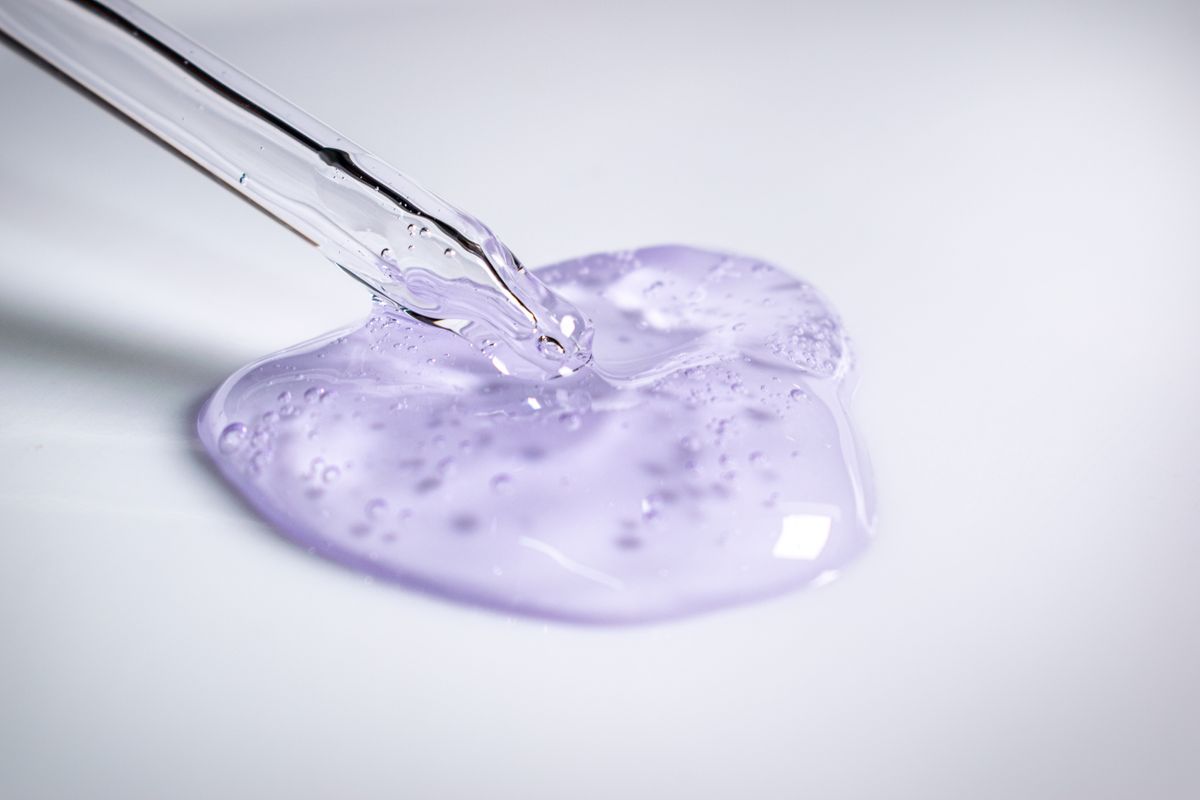
How are emulsions made in a factory?
The process is part of the formula. Two batches with the same ingredient list can differ in texture and stability if they are made differently. A typical hot-process cream is produced roughly as follows:
- The water phase and the oil phase are weighed and heated separately, commonly to around 70–80 °C so that waxes and fatty alcohols melt fully.
- One phase is added to the other under high-shear mixing or homogenisation, which breaks the dispersed phase into fine droplets.
- The emulsion is cooled under controlled, slower mixing; the cooling rate influences how the fatty-alcohol network sets and therefore the final viscosity.
- Heat-sensitive ingredients — fragrance, many actives, some preservatives — are added once the batch has cooled, often below about 40 °C.
- pH is adjusted and the batch is checked against its specification before filling.
Production-scale emulsions are usually made in vacuum emulsifying mixers, which combine heating, homogenising and scraping while drawing out air. Trapped air causes density variation, short fills and faster oxidation. Some emulsifier and polymer systems allow cold processing, which saves energy and time but narrows the choice of ingredients.
The hardest part is often scale-up. Shear rate, heating and cooling times, and mixing patterns in a large vessel are different from a laboratory beaker, so a cream that was stable at 1 kg can behave differently at 500 kg. The reasons are discussed in more detail in this article on why a formula that works in the lab can fail in the factory. Process parameters — temperatures, mixing speeds, homogenising time, order of addition — belong in the batch manufacturing record, which good manufacturing practice guidelines such as ISO 22716, the international GMP standard for cosmetics, expect to be documented and followed.
Water quality matters too, because water is usually the largest ingredient in an oil-in-water cream; dissolved minerals can interfere with some emulsifiers and thickeners, as covered in this guide to purified water in manufacturing.
How is emulsion stability tested?
Stability has to be shown, not assumed. The ISO technical report on stability testing of cosmetic products (ISO/TR 18811:2018) reviews available methods but deliberately does not prescribe one protocol, because products and storage conditions vary too widely; the responsibility for defining and justifying the protocol sits with the manufacturer. For emulsions, common elements include:
| Test | What it reveals |
|---|---|
| Storage at elevated temperature (often 40–45 °C) alongside room temperature | Accelerates separation, viscosity loss, colour and odour change |
| Freeze-thaw or temperature cycling | Weakness to the swings seen in shipping and warehousing |
| Centrifugation | A quick screen for creaming tendency during development |
| Viscosity, pH and appearance at set time points | Gradual drift that can signal structural change |
| Microscopy or droplet-size measurement | Coalescence and Ostwald ripening before they become visible |
| Testing in the final packaging | Interaction with pumps, tubes and liners; weight loss; dispensing performance |
Accelerated results support, but do not replace, real-time data; the logic of shelf-life claims is explained in this practical guide to stability testing and shelf life. Because the water phase of an oil-in-water emulsion can support microbial growth, preservative efficacy testing is a separate requirement, described in this article on preservatives and challenge testing.
In Malaysia, cosmetic products must be notified to the National Pharmaceutical Regulatory Agency (NPRA) before sale, and the company placing the product on the market remains responsible for its safety and quality. Stability data for an emulsion is part of the evidence that supports that responsibility and the product’s stated shelf life.
What should a brand owner check when evaluating a cream sample?
A sample that feels excellent on the first day can still fail at month six. Practical checks a non-chemist can make, and questions worth asking the development team:
- Keep a retained sample at room temperature and another in a warm place for several weeks; look for oil on the surface, a watery layer, graininess or a change in smell.
- Test it in the intended pack. A cream that sits well in a jar may clog or spit from an airless pump.
- Ask what emulsion type it is and why that type was chosen for the target skin feel and climate.
- Ask for the viscosity and pH specification, including the accepted range, so later batches can be compared.
- Ask which stability conditions have been run, for how long, and in which packaging.
- Check late changes. Adding a new active, more fragrance or a different oil after the stability study can invalidate it.
A structured approach to comparing rounds is set out in this guide to evaluating product samples. Emulsion design, droplet-size control and stability planning are core parts of cosmetic product development and formulation work, and are usually resolved during sampling rather than after launch.
Common mistakes: approving a texture without any heat or cycling test; changing the oil blend late without re-checking emulsifier balance; assuming a stable laboratory batch guarantees a stable production batch; and choosing packaging after the formula is fixed instead of testing them together.
Frequently asked questions
Is a separated cream still safe to use?
Separation is a physical defect, not automatically a safety problem, but it is a warning sign. Uneven distribution can mean some portions carry more or less of the active or preservative than intended, and a broken emulsion can protect microbes less well. A brand should treat separation within shelf life as a quality complaint and investigate the batch.
Can a separated product just be re-mixed?
Early creaming or flocculation may reverse with mixing, which is why some products are labelled “shake well”. Once coalescence has occurred the droplets have merged, and re-mixing will not restore the original structure or texture.
Why does my lotion get thinner in hot weather?
Heat lowers viscosity, speeds droplet movement and can soften the fatty-alcohol network that gives creams their body. A formula intended for tropical markets such as Malaysia should be tested at elevated temperatures and in the real packaging, not only in an air-conditioned laboratory.
Are cold-process emulsions worse than hot-process ones?
Not inherently. Cold processing relies on emulsifier and polymer systems designed to work without heat. It can save energy and protect heat-sensitive ingredients, but it limits ingredient choices — waxes and many butters need melting — and still requires the same stability testing.
Does “emulsifier-free” mean more natural or more stable?
Not necessarily. “Emulsifier-free” products are often stabilised by polymers, particles (so-called Pickering emulsions) or are not emulsions at all. The claim describes a technical approach, not a quality or safety advantage, and should be supported like any other claim.
How long does emulsion stability testing take?
Screening tests such as centrifugation give early signals within days. Accelerated storage commonly runs for around three months, while real-time data builds over the full intended shelf life. Timelines depend on the product, the market and the protocol the manufacturer has justified.
Sources and limitations
This article draws on ISO/TR 18811:2018 on cosmetic stability testing, ISO 22716 on cosmetic good manufacturing practice, public information from Malaysia’s National Pharmaceutical Regulatory Agency, and established colloid-science principles including the HLB system and Stokes’ law, all checked in October 2026. Temperatures and test durations are typical industry practice rather than fixed requirements; each manufacturer defines its own protocol, and regulatory requirements differ between markets and change over time. This is educational content, not formulation or regulatory advice for a specific product.
Creaton Poh is the pen name of Poh Tze Kheng, founder of ORIZI Group — one of Malaysia's most comprehensive one-stop OEM, ODM, private label and contract manufacturing groups, spanning skincare, cosmetics, personal care, perfume and fragrance, supplements, functional food and nutrition, pet care, home care and medical devices. Across six specialised companies and three manufacturing divisions, the Group brings together 20+ years of industry experience, 5,000+ formulations, and internationally recognised quality, manufacturing and regulatory standards. These articles are written to educate, not to promote.
Written by Creaton Poh
Industry Researcher • Author • Vlogger • Manufacturing Strategist
Turning ideas into products. Turning experience into knowledge.
Connect with Poh Tze Kheng on LinkedIn.


Comments
Post a Comment